Reign Advanced 275 0 Team 2015 Bicycle Blue Book
Giant's Reign 27.5 1 was not intended to be some glitzy carbon fiber runway model with a four-syllable name, predestined to headline global publications the day it was launched. Even with its bright yellow and orange graphics, Giant's top-of-the-range, 160-millimeter-travel, aluminum framed AM/trailbike would have been a wallflower at that dance. To appreciate the Reign 27.5 1 for what it is, scrap the red carpet and head for the forest.
Giant designed the Reign 27.5 1 to be capable of handling any and every situation that a top trail rider may face in the backcountry or at the bike park - either willingly or by mistake. Its lines are remarkably unremarkable, because the Reign's curved main tubes and Maestro dual-link rear suspension represent almost a decade of long-travel trailbike development evolution. Its profile may mirror its ancestors,' but the 2015 Reign 27.5 1 represents a leap into the future for Giant. Its geometry is long and low. Its suspension is tuned to reward high speed and courageous line choices, and its best-in-class component selection backs up that mission statement.
At $5975, the Reign 27.5 1 costs three thousand dollars less than a carbon uber-bike and it still checks all of the boxes, with headliners like a RockShox Reverb Stealth dropper post, Pike RCT3 fork, and Monarch Plus Debonair RC3 shock. It also sports DT Swiss Spline One Wheels and a race-ready Maxxis Minion/High Roller II tire combo. Add a SRAM X1 one-by transmission backed up by an MRP chainguide, then bolt all those goodies onto a trail-proven suspension chassis with a 65-degree head tube angle and if you do not begin to visualize shred, I'd suggest a brain scan.
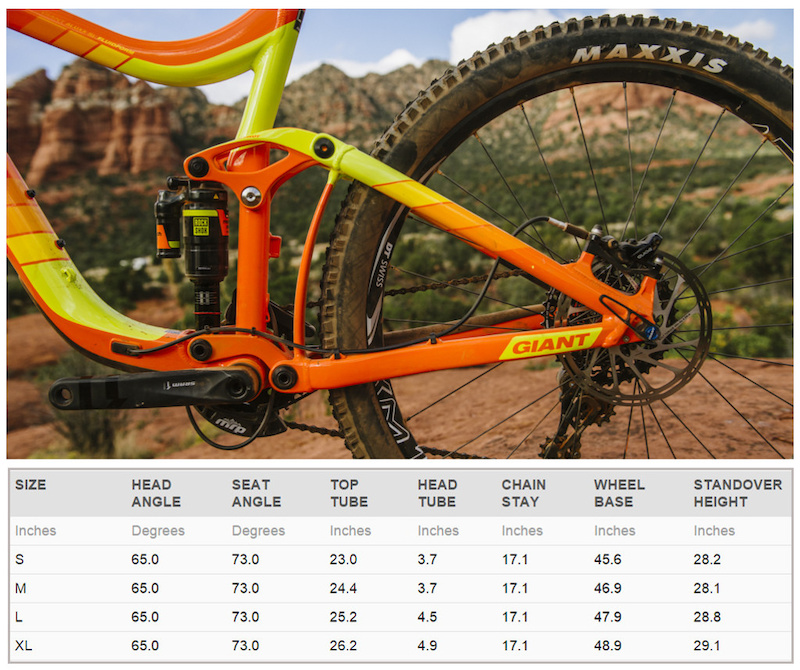
Details:
• Purpose: All-mountain/trail and enduro competition
• Frame: high-strength 6011-alloy aluminum frame, butted and manipulated tubes, 160mm Maestro dual-link suspension, ISCG 05 guide mounts, internal cable and hose routing.
• Fork: RockShox Pike RCT3 Dual Position Air, 160/130mm
• Shock: RockShox Monarch Plus Debonair RC3
• Transmission: SRAM X1, 11 x 42, eleven-speed
• Chain Control: MRP AMG, with bash guard
• Brakes: SRAM Guide, Rotors - (F) 200mm, (R) 180mm
• Wheels: DT Swiss Spline One, 27.5"
• RockShox Reverb Stealth dropper post
• Sizes: Small, Medium, Large
• Weight: 29.04 pounds, (claimed)
• MSRP: $5975 USD
• Contact: Giant Bicycles
Construction
Giant calls it ALUXX SL-grade aluminum, which is marketing speak for high-strength 6011-alloy tubes that are given the royal treatment, with advanced butting techniques and a combination of hydro-forming and air-forming methods that Giant developed to squeeze the tube walls thin where stresses are light, and to thicken them or to increase their diameters where greater strength is necessary. Nothing new there, but Giant is better at it than most, because they do it all in their factory. Giant also uses two-pass welding techniques to create a flush, smooth connection between parts - a method which is proven to increase the durability of aluminum frames.
Geometry improvements for 2015 begin with longer top tubes across all the sizes - over an inch in most cases. The adjustment was done to keep the reach climbing friendly while compensating for shortened stems. Our large sized test bike had a 25.2-inch top tube, paired with a 60-millimeter stem. Typically, large size top tubes run in the 24 to 24.5-inch range. The good news is that Giant, and other industry leaders have finally accepted short stems as a benchmark and are putting medium riders back on medium sized frames. A few test riders commented that they would probably revert from their preferred large size to the Medium Giant, so read and note the geometry chart before you make your purchase.
Other noticeable changes were a low bottom bracket, which measured 13.6 inches (345mm), and a slack, 65-degree head angle. The combined effects of the two changes should greatly enhance the bike's descending and technical handling - but to the point where it would steer like a stubborn mule at slower, singletrack speeds. Giant, however, brought the chainsay length in to 17.1 inches (434mm), which is short for 27.5-inch wheels, to sharpen up the Reign's climbing and cornering manners. Plenty of stand-over clearance (28.8 inches on the large frame), allows customers to select their sizing based upon the length of the cockpit rather than how much bike will fit between their legs. Short head tubes help reduce the stack of the bike's 160-millimeter-stroke front end, which further minimizes the big-bike proportions of the 2015 Reign.
Details call attention to almost every viewing angle, with rubber plugs sealing the internal cable and hose entries and a molded rubberized rock protector on the down tube. A rubberized chainstay guard silences any chain slap that gets past the bike's SRAM clutch derailleur and a screw-on cap disguises the direct-mount front changer boss. Giant chose a wider, 92mm press-fit-type bottom bracket shell to further enlarge the diameters of the frame members there in an effort to boost rigidity. ISCG 05 chain guide bosses are standard fare below and up top, Giant's tapered steerer fits standard 1.125-inch stems again. Hydro-pack haters can rejoice knowing that at least one large bottle will fit in the normal down tube location. Giant even added external dropper post fittings, anticipating the rare occurrence that a Reign owner may want to pitch the Reverb Stealth for another option.
Suspension
Two-position forks are a useful compromise for long-travel trailbikes with slack head angles, because the short-travel option feels firmer under power and the steeper head tube angle that is produced helps to keep the bike steering straight uphill. The RockShox Pike Dual Position Air fork drops 30 millimeters, from 160 to 130, which in turn lowers the bottom bracket height about one centimeter and increases the head angle a bit more than one degree. RockShock's Dual Position dial is on the left side of the fork crown and is easily accessed and manipulated.
Maestro rear suspension has been honed to the extent of its capabilities, at least within the realm of all-mountain and trail riding. The instant center (the calculated swingarm pivot location at at given point in the suspension's travel), of the Reign's dual-link design begins well forward and slightly above the bottom bracket axle and then migrates downward in a gentle curve towards the bottom bracket. By contrast, most dual-link designs are configured with much higher instant centers at the beginning of their travel to mechanically produce firm pedaling action. Maestro's kinematics are also designed to provide firm pedaling, but they are biased towards maintaining supple suspension action and also to uncouple braking forces from the suspension. Giant expects Reign pilots to augment the Reign's pedaling platform with the Monarch shock's three-position, low-speed compression lever as necessary. Giant builds just enough pedaling platform into Maestro, so that the bike can climb and accelerate with a degree of efficiency with its shock and fork wide open, which is a perfect compromise for the Reign 27.5 1. All-mountain riders and enduro racers expend most of their climbing efforts to enjoy the following descents. Like we discovered, most riders will only flip the lever for extended climbs and leave the suspension open for everything else.
Giant constructs the Reign's rear suspension to take a beating, with beefy tubes and large, easy-to-service pivot axles and sealed bearings. The lower shock shaft extends through the frame and doubles as the axle for the suspension's rocker arm. Lower suspension rockers are offset to the left to provide a stiffer, wider stance for the bearings and axle, and also to clear space for a phantom front derailleur which will most likely, never be fitted to a Reign 27.5 1. Tire clearance is reasonably good, which is uncommon for dual-link suspensions, because the triangulated swingarm and its lower links are forced to occupy the same space behind the bottom bracket. The swingarm appears to have ample clearance for DH-width rubber, but the crown of the tread may get close to the vertical strut that unites the seatstay and chainstay yokes.
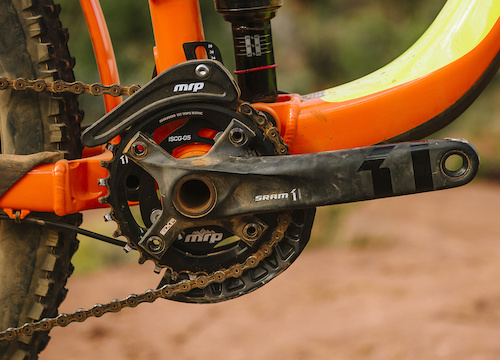
Components:
| Specifications | ||
| Release Date | 2015 | |
| Price | $5975 | |
| Travel | 160mm | |
| Rear Shock | RockShox Monarch Plus Debonair RC3 | |
| Fork | RockShox Pike RCT3 Dual-Position Air, 130-160mm travel | |
| Headset | Giant Overdrive, tapered | |
| Cassette | SRAM XG1180 10x42, 11-speed | |
| Crankarms | SRAM X1, 32T | |
| Chainguide | MRP AMG | |
| Bottom Bracket | SRAM, Press fit | |
| Pedals | NA | |
| Rear Derailleur | SRAM X1 Type 2 | |
| Chain | KMC X11SL | |
| Front Derailleur | NA | |
| Shifter Pods | SRAM X1 | |
| Handlebar | Giant Contact SL DH, 31.8mm | |
| Stem | Truvativ Holzfeller | |
| Grips | Giant Lock-on | |
| Brakes | SRAM Guide, Rotors: [F] 200mm [R] 180mm | |
| Wheelset | DT Swiss Spline One | |
| Hubs | DT Swiss Spline One | |
| Spokes | DT Swiss | |
| Rim | DT Swiss Spline One | |
| Tires | [F] Schwalbe Magic Mary, Trailstar, Snakeskin, Race Guard, 27.5x2.35, [R] Schwalbe Hans Dampf, Pacestar, Snakeskin, Race Guard, 27.5x2.35 | |
| Seat | Fi'zi:k Tundra M5 | |
| Seatpost | Rockshox Reverb Stealth, 30.9mm | |
 | Turns out that the Reign 27.5 1 is one hell of a descender and one the most well mannered all-mountain bikes we have thrown a leg over this year. |
Leaning beside a dozen carbon fiber superbikes, Giant's aluminum-framed Reign 27.5 1 did not jump out as the first choice for a tough lap around Sedona, Arizona's, red rock. When we did trot the Reign out of the barn and head for trails, we were rewarded. Turns out that the Reign 27.5 1 is one hell of a descender and one the most well mannered all-mountain bikes we have thrown a leg over this year. We quickly learned that the key to squeezing the most from the brightly colored Giant was to tune the suspension to highlight the type of riding we would be doing on that particular day.
Setup: Giant is large enough (no pun intended) to have its suppliers provide custom tunes for its shocks and forks and such is the case with the Reign 27.5 1. Test riders liked the performance of its RockShox Monarch Plus Debonair RC3 shock, but the added air volume of the Debonair sleeve required us to pressurize the shock's air spring 40 to 60psi higher than our typical settings. Riders who weigh in excess of 200 pounds may need to add volume adjustment spacers to prevent bottoming, although RockShox tells us that the Monarch Plus is rated up to 350 psi. The Reign descends best with 35-percent sag in the shock, but it pedals and climbs best with the air pressure set to produce slightly less than 30-percent. Most of us favored the gravity tune and climbed with the Monarch's low-speed compression level in the middle, "trail" position.
The fork is a different story, because the spring pressure seems inconsistent between the 160 and 130-millimeter travel options. Tune the Pike Dual Position fork for descending, with the spring pressure set just high enough to keep it from diving under braking and it will be too soft in the short-stroke option. The 160-millimeter setting becomes way to stiff when the spring is set firmly enough in short-travel mode. In the end, it doesn't matter because most riders quickly learn to avoid the fork's 130-millimeter travel setting because it lowers the already low bottom bracket to the point where the cranks do more trail maintenance in one ride than an Arizona trail crew does following three days of rain. One or three Hail Mary pedal strikes were enough to convince test riders to leave the fork at 160mm. Giant should do a mid-year upgrade to the better-performing standard Pike fork and call it a win for everybody. In the meantime, set your Dual Position Pike up for optimum performance in the long-travel mode and leave that black dial alone.
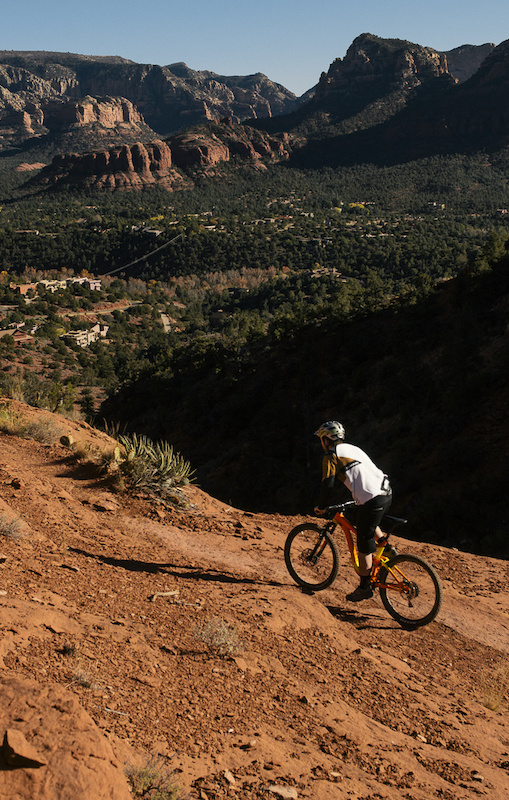
| | When the Giant is up to pace, its efficient Maestro suspension and low center of mass work together to maintain momentum. |
Pedaling: At 30 pounds, the Reign will not impress cross-country racers with brisk acceleration, but it does respond to pedal pressure with enough authority to prevent editors who have become jaded from reviewing $10,000 carbon machines from writing bad stuff about it. When the Giant is up to pace, its efficient Maestro suspension and low center of mass work together to maintain momentum - a very positive trait in Sedona, where devil trail builders seem to have purposely embedded millions of oddly-placed stones to suck speed from your legs. Red rock trails are a testament to the efficiency of active rear suspension, so it is no surprise that bikes like the Giant Reign and Specialized Enduro do so well there.
Climbing: Mid-sized wheels add the equivalent of two chainring teeth to the gearing of a conventional, 26-inch bike, so the Giant's 32-tooth chainring is as much gear as a trail rider would want to push up a steep grade. I would have chosen a 30-tooth for the punchy climbs that characterized most of the riding I did, but those who had the legs managed personal-best performances aboard the Reign, scratching up technical climbs that stymied efforts aboard the other thoroughbreds in our stable.
Switch the shock to Trail mode, because the additional pedal firmness makes a noticeable improvement - especially on tired legs. Perhaps more beneficial is the support that the additional low-speed compression adds to the rear suspension, which lifts the tail of the Giant and keeps the rider in a more effective pedaling position. The Reign's chubby frame and supple suspension give up some climbing performance over its expensive rivals on smoother, faster ascents, but its long wheelbase, excellent balance and predictable steering become undeniable assets when climbing steep and chunky sections.
Cornering: Few bikes with the Giant's 48.9-inch wheelbase could even pretend to corner well, but somehow, the Reign gets around the bends quite well. The bike's length keeps the front tire planted, and Giant paid special attention to matching the bike's 65-degree head angle, 27.5-inch wheel and the fork offset, so the steering feels lighter and more precise than most would expect.
When descending, we learned to take a little wider line at the entry point and then swoop into the turn - a strategy which cut a tight apex for both fast corners and tight switchbacks. Steep, climbing turns gave some riders trouble, however, because the slack steering angle would initiate a push unless the rider took preventative action.
If the bike could choose, the Reign would pass on the twisty forest singletrack and head for high-speed trails peppered with berms and breath-holder technical lines that one would expect to find hidden in the out-of-bounds regions of bike parks.
Technical descending: Test Rider Wayne Wonnacott summed up the Giant's descending performance best: "It's a downhill bike. In fact, its better than a downhill bike because the average person can still play on it. I would ride it at Whistler and still have tons of fun. All the things that hurt it on the ups make it a machine on the downs."
Much like a DH bike, the Reign 27.5 1 feels planted where many bikes in its class are bouncing over rocks, roots and chatter, so its rider can concentrate on larger features or critical line choices. Its short chainstay doesn't require the rider to hang way off the back of the bike to weight the rear tire, which adds a measure of control and confidence for steep drops and boulder rolls. Much like a big bike, it carries a lot of speed everywhere on the trail, so it is easy to set up for features - and it manuals beautifully. There is no doubt that the Reign's frame numbers are heavily weighted towards descending, but some of the Giant's inspiring downhill handling is attributable to its no-nonsense component spec. The RockShox suspension is dialed and the cockpit is appointed with a wide, 780-millimeter handlebar; a short stem; powerful, easy-to-modulate SRAM Guide brakes; and a 125-millimeter dropper post. The Reign feels right because it offers the complete package.
| | Much like a big bike, it carries a lot of speed everywhere on the trail, so it is easy to set up for features - and it manuals beautifully. |
Technical Report
Tires: Giant's proper tire spec for the Reign 27.5 1 is a Schwalbe Hans Dampf rear and a Magic Mary front, which is an excellent combination. Our bike, however, came with a Maxxis Minion front tire and a High Roller II in the rear. While the fast-rolling and durable Maxxis tires were arguably the better rubber selection for the rocky and dry trails we spent most of our test miles on, we are left to wonder how the Schwalbe tires may have affected the outcome of this review.
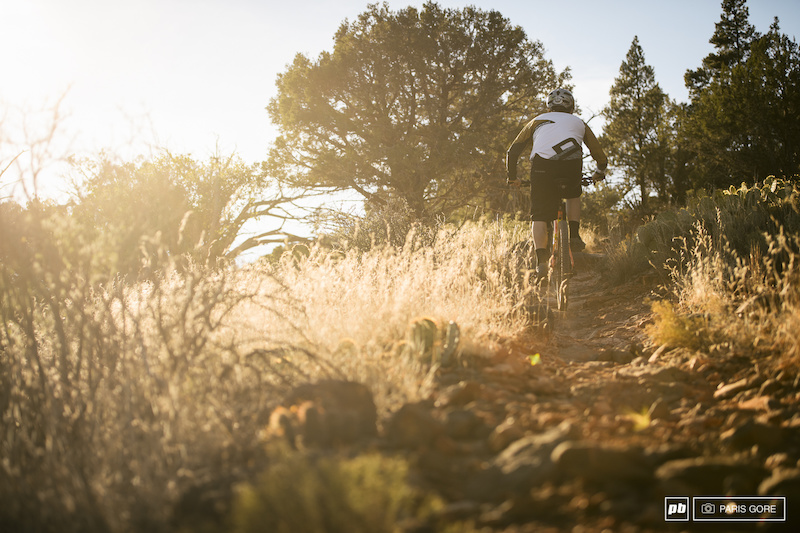
| | If you are strong, the surefooted Reign will get you up almost any climb. If not, it will make you strong. |
Brakes: SRAM's Guide brakes are impressive. The more we ride them the more we come to appreciate the sensitivity that they telegraph through the levers. We could keep the tires on the scratching edge of a lockup down steeps that would have normally been skid-fests. Guides are not quite as strong as Shimano XTR ICE brakes, but they can still bug your eyes out when configured with a 180 rear and a 200-millimeter front rotor.
Fork: Sorry, but Giant's choice of a Dual Position RockShox Pike was the only fail in the Reign's grocery bag. Test riders commented that the standard Pike was the better performer, with smoother small-bump performance and a better spring rate. Did we mention that in the 130-millimeter position, it is tough to ride on uneven terrain without bashing the pedals?
Chainguide: MRP's AMG guide is perfect for the Reign 27.5 1, because the low bottom bracket gives plenty of opportunity to use its sturdy bash guard. Its descending warrants a full DH guide, but not having to listen to the buzz of roller on the lower chain run was a wonderful thing when we were bashing out climbs.
Saddle: Fi'zi:k Tundra M5 must be a nom de plume for the Marquis de Saddle, because a dull ax may have been a more comfortable seat.
Shock: Everyone rushed for test bikes with velvet smooth Cane Creek DBinline shocks - which blew up shortly thereafter. By contrast, the Giant's RockShox Monarch Plus RC3 shock, with its Debonair volume can was nearly as smooth and was ready to rock, every day. Our initial worry about the Monarch was that it required a great deal of pressure to support average weight riders, and that the Reign's suspension may not support heavier riders, but RockShox says, "pump it up and ride."
Pinkbike's Take:
| | Giant took a small risk by designing the Reign 27.5 1 to be far more gravity specific than most of its competitors. Enduro racing, however, has encouraged a handful of bike makers to develop a sub-genre bike - one that emphasizes the downhill skillset in both the sturdiness of its chassis and with its longer, slacker frame numbers. Pedaling flat-out, while racing down timed sections which are largely steep and technical, weights the bike's handling at least equally to its pedaling efficiency. The Reign's frame construction and its component selection reflects the possibility that its future owner will be sending it like a big bike or racing Enduro World Series events. Instead of being a trail bike, modified with parts and geometry to help it descend better, the Reign is designed more like a downhill bike that has been configured to pedal efficiently. None of us would choose the Reign as our go-to trailbike, but everyone remarked that it would be an awesome ride for bike parks and for sessioning some of the more legendary technical trails at home to see if we could hit all the big bike features. Many AM/trail riders won't get it, but the new Reign is just right for talented riders who own long-travel trail bikes but find themselves wanting for more. If you wonder whether you should wear your full-face or half-shell each time you ride, then the Reign 27.5 1 is probably the bike for you. - RC |
Source: https://www.pinkbike.com/news/giant-reign-275-1-reviewed.html
0 Response to "Reign Advanced 275 0 Team 2015 Bicycle Blue Book"
Post a Comment